
By Liz Nye, New England Botanic Garden Staff
February 2026
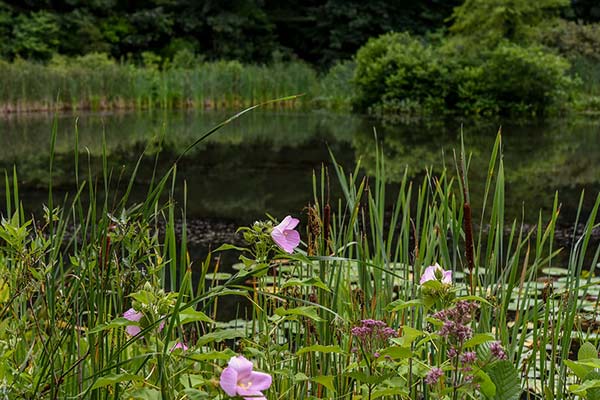
Marsh hibiscus, Joe-Pye weed, and cattails growing along the pond edges. Photo by Megan Stouffer.
Penny Spear Kaczyk remembers the day the Garden’s Wildlife Refuge Pond came to life. It was spring 2002. She was among one hundred or so people—family, friends, Garden staff, and supporters—who looked on as her father turned on a giant hose to fill the newly dug pond.
“The water came slowly, and in the beginning, it pulsed through the hose, almost like blood through veins,” she recalls. The symbolism was powerful to Penny—then and now—because the Hope H. Spear Wildlife Refuge Pond honors the life and legacy of her mother.
Hope Spear, who passed away in 1999, was the first woman to serve as president of the Worcester County Horticultural Society (WCHS). Her term, from 1988 to 1992, ushered in monumental changes. Just two years before her tenure began, WCHS purchased Tower Hill Farm in Boylston, MA and began building the botanic garden we know today. Hope had a hand in selecting the Garden’s location. While president, she also unveiled the Garden’s first Master Plan, oversaw the dedication of the Lawn Garden, and opened the Fuller Drive entrance. Her service to the Garden didn’t stop at the boardroom either; it was hands-on. She and her husband, Ivan, helped plant the first bulbs in the Field of Daffodils, acquiring poison ivy as a badge of honor in the process.
While Hope’s influence shapes many aspects of today’s Garden, Penny feels that the Wildlife Refuge Pond is the most fitting space to carry her mother’s name. Hope grew up on a farm in Rutland, MA, where a pond was the playground of her youth. At a young age, she developed a love for the natural world and the landscapes characteristic of New England, wetlands in particular.
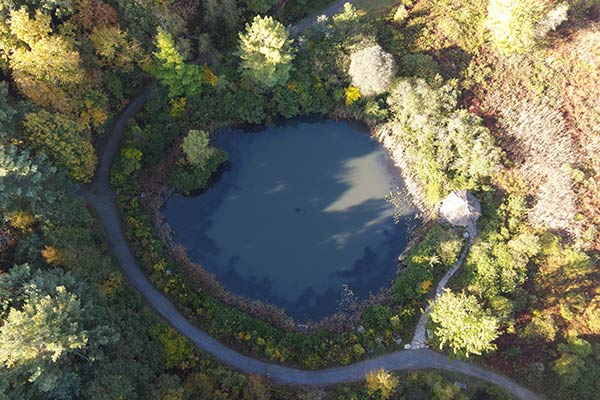
Aerial view of the Wildlife Refuge Pond. Photo by Megan Stouffer.
Building a pond at the Garden was an aspiration from the early days, but making it happen required years of planning and observation of how water moved and gathered across the property. Whether naturally occurring or artificial, ponds provide practical benefits to botanic gardens, managing stormwater by slowing runoff. Importantly to Hope, they also create vital habitat for wildlife, provide migratory corridors for waterbirds, and demonstrate the role plants play in complex riparian ecosystems.
“The Wildlife Refuge Pond is an incredible resource,” says Steve Conaway, the Garden’s Director of Horticulture. “Not only does it provide this beautiful focal point on the landscape, but it allows us to create an idealization of a natural environment and steward it with ecologically focused practices.”
Planting for Water-Loving Wildlife
When the Wildlife Refuge Pond was built, 2,000 native herbaceous and woody plants were included in the design. Shrubs like highbush blueberry (Vaccinium corymbosum), sweet pepperbush (Clethra alnifolia), spice bush (Lindera benzoin), and smooth withe-rod (Viburnum nudum) were chosen to provide food and cover to wildlife throughout the year. Inkberry (Ilex glabra) and winterberry (Ilex verticillata) feed birds like cedar waxwings, eastern bluebirds, and others in winter months when resources are scarce. Cattails (Typha latifolia) growing at the water’s edge beckon red-wing blackbirds, their song a welcome sign of spring. Come summer, perennials suited to streambanks and wet woodlands like marsh hibiscus (Hibiscus moscheutos), cardinal flower (Lobelia cardinalis), and blue flag iris (Iris versicolor) attract hummingbirds, butterflies, and bees.
The Wildlife Refuge Pond’s plant palette also includes specimen trees that are at home along wetland edges. These trees support the open pond habitat while offering interest to visitors as well. Three Atlantic white cedar trees (Chamaecyparis thyoides), rare evergreens with a narrow native range along the Atlantic coast, stand along the pond edge. Growing nearby, on either side of a path that winds around the pond, are several bald cypress (Taxodium distichum) and dawn redwood (Metasequoia glyptostroboides). These two deciduous conifers are members of the same plant family, Cupressaceae, and share certain qualities—they support aquatic ecosystems, display similarly conical architecture, and possess soft, needle-like foliage that drops seasonally. But while bald cypress can be found commonly across the southeastern U.S., the dawn redwood is endangered in its native range, central and western China.
“These trees echo each other but are very different specimens from very different parts of the world,” says Steve. “Offering distinct pairings that echo similar features is a classic trick of garden design and one of my favorites.” For visitors, the intentionality of the Pond’s planting design demonstrates that naturalistic gardens can be developed with an eye to beauty as well as function.
If You Build It, They Will Come
Last year, on a visit to the Garden, Penny Spear Kaczyk and her husband Gene Kaczyk toured the Wildlife Refuge Pond — “Hope’s Pond” as they lovingly refer to it—and were delighted to learn about the diversity of native wildlife that visitors and staff report seeing at the pond. A wide array of bird species are regular visitors. Green herons, hooded mergansers, and king fishers are occasionally spotted. Snapping turtles, muskrats, and even river otters make use of the pond’s resources, as do countless insects from dragonflies and damselflies to numerous native bees.
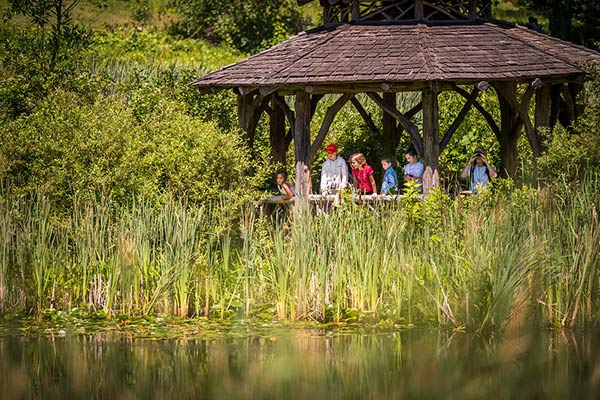
Nature observations at the Pond are a must for youth education programs. Photo by Troy B. Thompson Photography.
Ongoing stewardship and careful curation continue to enhance the Pond for the benefit of wildlife and human visitors, too. As the original planting did not focus on the showiest plants but rather what you would find in a naturally occurring wetland, the horticulture team recently boosted the floral display with over 40 Rhododendron plants. This 2022 addition adds visual interest along the pond banks and contributes nectar resources for pollinators like bumblebees. Enhancements include built structures as well. In 2023, several nesting boxes were incorporated to support wood ducks, a strikingly colorful migratory duck that resides in Massachusetts from March to October.
With generous support from the Kaczyk’s in 2024, tree maintenance around the pond opened sight lines that improve nature observation experiences and provide better access for youth education programs—the Pond is a favorite stop on school field trips. Removing trees with shallow, spreading root systems like poplars, birches, and willows protects the integrity of the Pond long-term. A gift from Penny and Gene also funded much needed repairs to the Rustic Overlook, a viewing structure nestled into the hill above the Pond, and the purchase of a small boat and waders that help the horticulture team conduct regular pond maintenance.
The Wildlife Refuge Pond is a Garden highlight to discover in any season—and so is its story. What began as a shared love of the Garden has become a commitment carried forward by multiple generations. From its history and its namesake to its ecological impact and the ways it engages visitors of all ages today, the Hope H. Spear Wildlife Refuge Pond remains a symbol of vitality. It offers wildlife essential habitat and people something critical, too—a sense of optimism in the knowledge that we can support healthy ecosystems when we make the choice to.
“Hope,” says, Penny Spear Kaczyk, should be the parting message for any visitor to the Pond. “It is not just my mom’s name, but how she lived her life.”
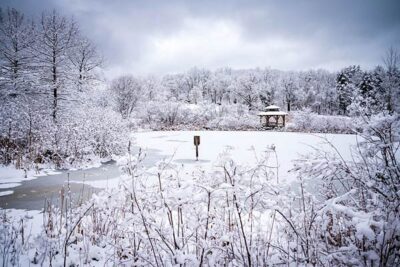
Winter at the Pond. Photo by Troy B. Thompson Photography.
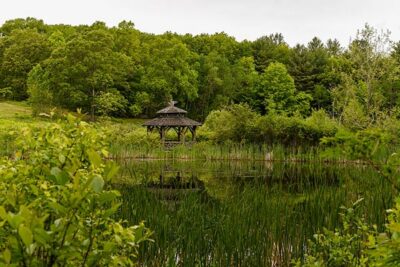
Summer at the Wildlife Refuge Pond. Photo by Megan Stouffer.
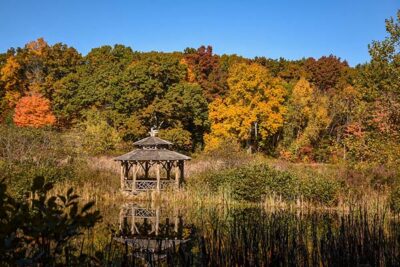
Fall foliage at the Pond. Photo by Megan Stouffer.
Liz Nye is the Public Relations Manager at New England Botanic Garden. She holds a master’s degree in science writing from Johns Hopkins University and enjoys learning about and writing about all things plants.