
By Kiley Jacques, Naturalistic Gardener
May 2026
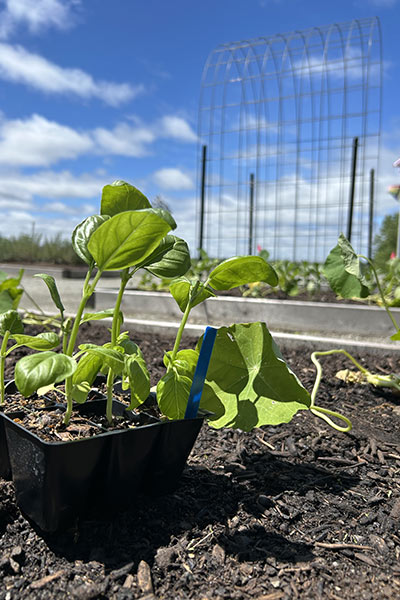
Spring planting time
Since its inception, the Climate Garden has been a space under constant development. When I came onboard as naturalistic gardener in May 2025, I learned early on that the omnipresent potential for change that is palpable in this garden reflects the core mission: adaptability. This is a statement with many subtexts, so before getting into the weeds (ahem), it is important to answer a common question from visitors: “What is the Climate Garden?”
In a Nut
Built in 2023, the Climate Garden sits on the property’s west-facing edge, hugging an exposed bluff with a view toward Mount Wachusett and the reservoir. This water resource—just a rock’s toss away—provides an excellent opportunity to implement and teach sensitive land management and water stewardship.
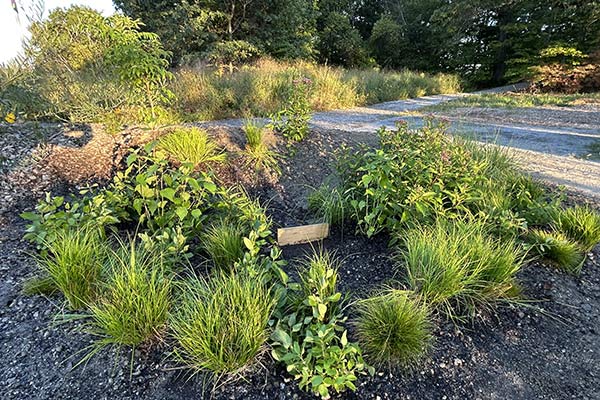
Rain garden installed in 2025
The Climate Garden includes raised beds for growing vegetable and herb crops, native plant communities for attracting pollinators, a green roof (coming soon!) and a rain garden for stormwater management, a pollinator strip and biodiversity meadow for viewing local ecology in action—meaning diverse plant, insect, and wildlife species and their behaviors—and berry-rich edible landscapes, among other features.
This space considers our planet’s changing environmental conditions and poses resilience-planning as a solution. Plant selections are based, in part, on species’ capacity to withstand extreme climate variations.
The Climate Garden is intended to change seasonally and programmatically, while consistently illustrating ecologically sensitive gardening methods, as well as water conservation strategies and ways to add biodiversity to the landscape—and why.
Toward this end, low-impact design elements, like easily shifted structures made from natural materials harvested onsite, and permeable surfaces, like the stone dust paths and large wood-chipped gathering area, combine for a readily alterable, easily inhabited, and naturalist setting.
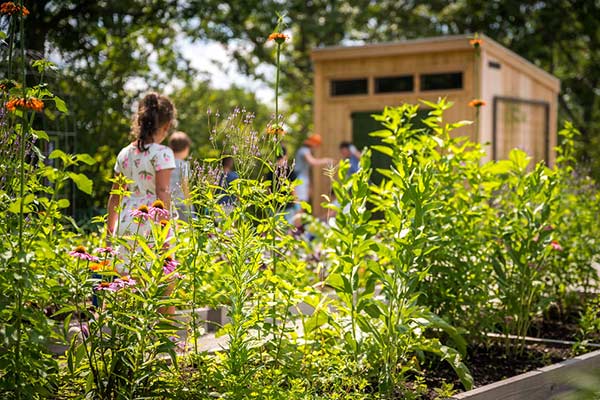
Youth programming in the Climate Garden
Hardworking Space with Youth at Heart
This is a youth-focused space, where we connect young visitors and program participants to nature through experiential learning activities.
The Garden’s horticulture and youth education teams collaborate to select seasonal crops to teach young people food-growing skills—from soil science to seed sowing to crop harvesting—as well as lessons around climate change and sustainability.
Because the Climate Garden is still new and growing in scope, interpretive signage is in the works. It will help all visitors navigate the space with a fuller understanding of its objectives. The key concepts are ecological gardening practices, climate–adapted / alternative crops, natural resource conservation, the importance of native plants and biodiversity, youth education through engagement, and the value of good design.
A Closer Look
Collaborations are underway with local cultural community groups to support crop selection and stewardship in several of the beds. Two of the plant beds demonstrate climate-adapted species, meaning those that have already proven themselves resilient in other parts of the world, withstanding extreme temperatures and weather conditions. Many of these same crops offer additional benefits, including culinary diversity and cultural connection.
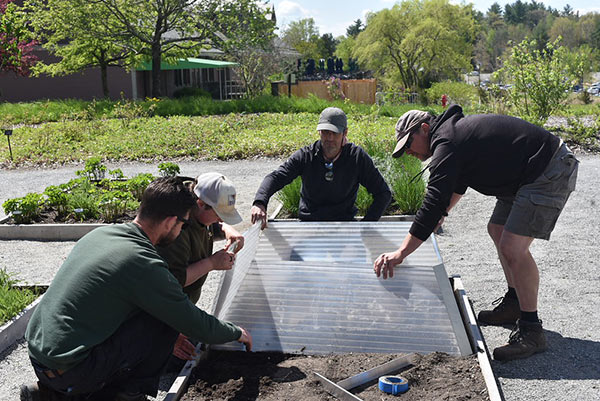
Installing a prototype of an open top chamber
Community science opportunities are on deck too. In collaboration with partners at the University of New Hampshire, we are adding open-top chambers (OTC) for climate-comparison studies. These experimental chambers change the growing conditions to mimic the extreme stressors expected with progressive climate change. These studies demonstrate the potential effects on our garden plants. Offering alternatives to vulnerable crops is part of the mission here. If we know which crops are susceptible to failure, we can instead select climate-adapted species.
A new biodiversity meadow has been planted between the Climate Garden and The Ramble. It features plants from our pollinator strip that provide habitat for insect and bird pollinators, as well as other wildlife. The idea is for visitors to see plants up close in raised beds where they can study their botanical characteristics and then explore those same plants in a more naturalistic setting, where they are part of the greater landscape.
High- and low-bush blueberry, raspberry, elderberry, and goji berry shrubs, among others, create an “edible landscape” with biodiversity benefits. Underplanted with strawberries, this area also demonstrates a lawn alternative, or “steppable” groundcover, that can be used in lieu of turfgrass, a resource-intensive monoculture that warrants reconsideration.
A small crabapple orchard on the southwest edge of the Climate Garden supplies native bees with critical early spring nectar and pollen. The Malus spp. trees also support birds and Lepidoptera larvae.
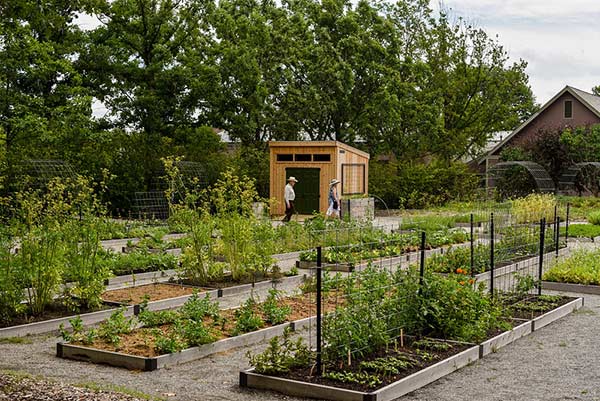
Summer 2025 in the Climate Garden
Visitors Takeaways
Climate Garden visitors should walk away with ideas for supporting a climate-resilient local ecology. Planting perennial food crops, removing invasive and non-native plants from your property, neighborhood, or town, and incorporating more native species to encourage biodiversity are some of the suggestions at play in the Climate Garden.
In short, there is a lot happening in the Climate Garden! It warrants a visit, at least. Our hope is that one or more of its offerings will interest you in returning for further observations (and possible participation). After all, that is what gardening is all about… watching, learning, and trying different things over time.
The big-picture hope, of course, is that our efforts—combined with those that Garden visitors make—help to mitigate the worst of climate change and its predicted outcomes. It is an important conversation and one to be had in the Climate Garden, where finding solutions is our work.
About the Author
Kiley Jacques is a former magazine editor and freelance writer. She was a professional gardener for 22 years prior. That time included seven years at the Woodland Park Zoo in Seattle, Washington, where as senior gardener, she transitioned the historic Rose Garden from conventional to natural management methods.