
By Liz Nye, New England Botanic Garden
July 2026
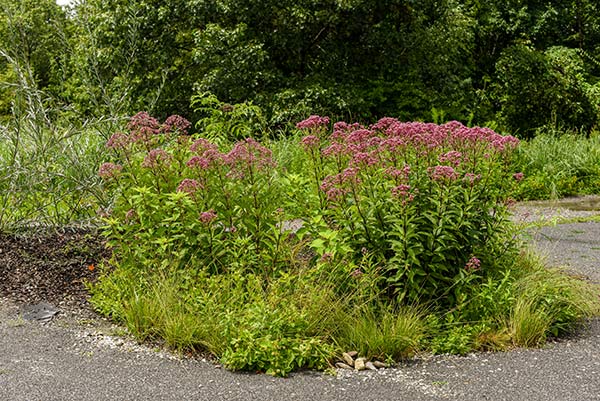 Gardening with water in mind looks different in the era of climate change. In New England, we often face too much rain or too little. No matter how you add it up, it equals a lot of uncertainty.
“Many of us have likely taken consistent water for granted,” says Steve Conaway, the Garden’s director of horticulture. “Now we need to embrace a more sophisticated approach that considers our gardens and their connections to the broader climate and environment.”
In 2025, the Garden’s horticulture team installed a rain garden in the Climate Garden. It’s one component, Steve explains, of a larger vision to think holistically about water as a resource and showcase plants and practices that can withstand extremes.
What Does a Rain Garden Do?
Planted in shallow depressions, rain gardens capture stormwater with native plants whose vast roots stabilize soil and efficiently soak up water. The idea guiding rain garden design is simple: Mimic the natural hydrological systems that human development disrupts. Our built environment, full of impervious surfaces, transforms what once worked like a sponge into a funnel. Huge volumes of stormwater move too quickly from our roofs and roads into streams and rivers. For every 100 square feet of roof surface, one inch of rain produces 62 gallons of water. That could add up to a small swimming pool’s worth of water per home in each storm.
 As our climate warms, periods of drought punctuated by brief, heavy storms become more common. These storms can have negative effects. While they may perk up some plants temporarily, they often fail to recharge groundwater supplies.
“When thoughtfully designed and executed, rain gardens can represent an ideal example of ‘green infrastructure’ taking on the function of industrial drainage and filtration systems while making space for the biological diversity of a living landscape,” Steve says.
Rain Gardens Then and Now
A group of housing developers and urban planners in Maryland are credited with popularizing modern rain gardens through a project that got the federal government’s attention in the 1990s. They proposed plants as a cost-effective alternative to traditional water retention and drainage systems. More than three decades later, rain gardens and bioswales, as the larger, more complex designs are now known, can be found in the streetscapes of cities and towns from Boston to Seattle.
On Staten Island, the Another large example, the Bioswale Garden at Cornell Botanic Gardens, eliminates 78,000 gallons of stormwater runoff each year. With over 100 different flowering perennials, sedges, shrubs, and trees, the Bioswale Garden is a beautiful and powerful demonstration of sustainable design.
When it comes to rain gardens at the home scale, many nonprofit organizations, extension schools, and state agencies provide resources to help plan site-specific gardens. (Check the ‘Resources’ section at the bottom of this post for more.)
The Garden Team’s Plant List
When choosing plants for a rain garden, look for deep-rooted native plants that will draw water from the surface and ensure it infiltrates into the soil.
“Adaptable species tolerant of flooded conditions as well as stretches of drought are perfect for New England rain gardens,” Steve says.
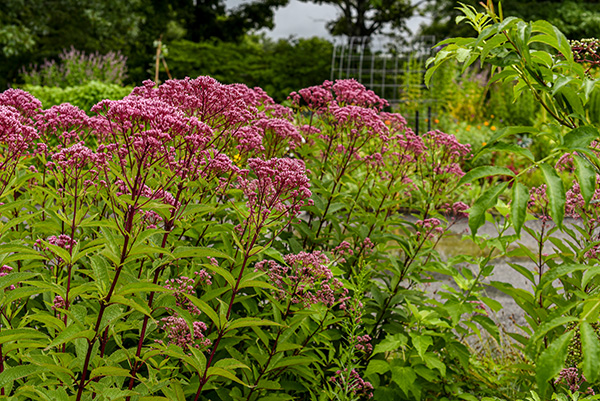 With a diverse palette of native plants to explore, there’s no reason to sacrifice beauty over function. In fact, curb appeal is one factor that makes rain gardens popular among green infrastructure solutions. A few plants to consider include:
- Buttonbush (Cephalanthus occidentalis ‘Crimson Comets’): This shrub can tolerate flooding, making it a solid choice for rain gardens. It has an open, rounded habit and can grow up to 12 feet. Distinctive globe-shaped flowers add visual interest. ‘Crimson Comets’ delivers striking red foliage in the fall.
- Joe Pye weed (Eutrochium dubium ‘Baby Joe’): Also called coastal plain Joe Pye weed, this herbaceous perennial is a wetland species that adds structure to a rain garden. It can grow several feet tall, though ‘Baby Joe’ is a more compact, clumping cultivar. Cloud-like flower heads feature dusty pink blooms that attract pollinators.
- Swamp rose mallow (Hibiscus moscheutos): This woody plant enjoys wetland margins. It’s known to be a prolific flowerer featuring dramatic pink blooms.
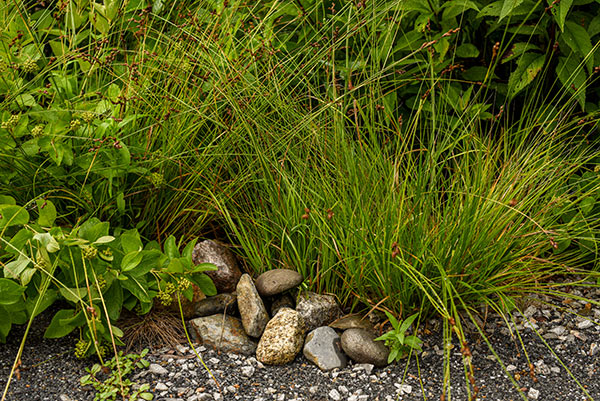
- Tussock sedge (Carex stricta): At home in marshes, bogs, and other sites that experience seasonal flooding, this sedge forms large dense clumps. In a rain garden, it is best suited for the lower areas that remain wet longer. It helps stabilize soil, and like other Carex species, provides food and shelter for wildlife.
- New Jersey tea (Ceanothus americanus): This small shrub is a prairie plant with exceptionally deep roots. It fixes nitrogen in the soil and features tiny white flowers that form in clusters.
- Beard grass (Anatherum virginicum): A rugged, adaptable native grass that will hold soil at the edges of rain gardens and withstand severe drought between storms. Bushy seedheads impart texture and interest into the winter.
RESOURCES
- Stormwater Solutions for Homeowners Fact Sheet: Rain Gardens, Mass.gov
- Rain Gardens: A Way to Improve Water Quality, UMass Extension
- Rain Gardens, American Society of Landscape Architects
- Rain Gardens, Massachusetts Watershed Coalition
About the Author
Liz Nye is the Public Relations Manager at New England Botanic Garden. She holds a master's degree in science writing from Johns Hopkins University and enjoys learning about and writing about all things plants.