
By Liz Nye, NEBG Staff
September 2026
Water gardens in New England reach their peak as summer transitions to fall. Lush and likely supporting healthy frog populations by now, these garden features have a special way of captivating us.
"Aquatic gardening offers a wide and sometimes unexpected plant palette," says Steve Conaway, the Garden's Director of Horticulture. "You can work with obligate aquatic plants that are submerged, floating aquatic plants that are barely even rooted, and then plants that are marginal, that grow at the edges of wetlands."
Inspired by interesting aquatic plant adaptations, Steve and the horticulture team took a new approach to the seasonal display in the water feature of The Ramble this year. In our garden for children and families, they installed a vibrant ornamental container display with a surprising through line—all the water-loving plants featured are edible.
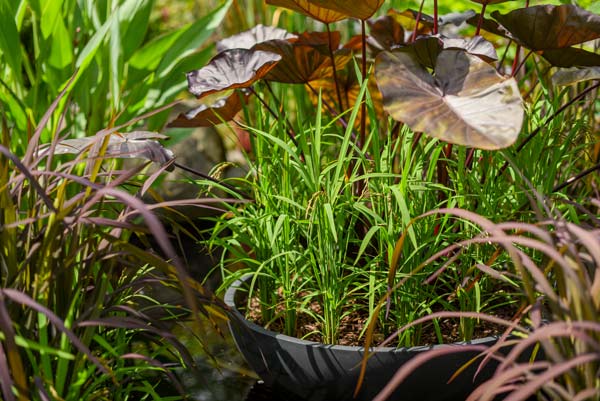
'Purple Tiara' grows with another edible aquatic plant, taro.
The Plant "Palate"
"When we think of edible aquatic plants, the first one that people tend to think of is rice," Steve says. "Farmers from around the world grow rice in paddies that are completely submerged, conditions not necessarily required by the rice plant but employed to suppress weeds."
Three varieties of the global food crop Oryza sativa grow in The Ramble pool. 'Scarlett,' a nutritious red rice, 'Purple Tiara,' and 'Black Madras', an ornamental variety, mingle in sunken containers as well as shallow, above-water containers. The design demonstrates the plant's ability to thrive in vastly different conditions. By this time of year, the grains of 'Purple Tiara' are full and recognizable as they bend the delicate rice stems down toward the water.
Growing nearby, visitors can find a towering example of manoomin (Zizania aquatica). Though it's also known as wild rice, this native species is not closely related to Oryza sativa. Manoomin (Zizania aquatica and Z. pulustris) establishes in mucky substrate, can grow up to 10 feet tall, and produces a protein-rich grain. It's an important plant in Ojibwe culture, and in the Great Lakes region, manoomin is stewarded by tribal organizations. Grains, which begin to ripen in early September, are traditionally harvested by canoe and then processed into a valued seasonal food.
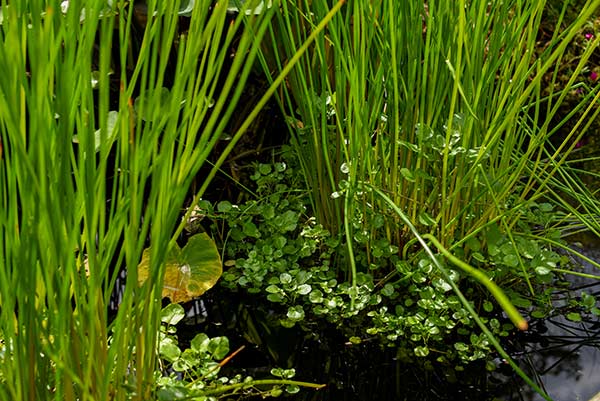
Chinese water chestnut grows upright with watercress spilling over the edges.
Most edible aquatic plants are not like rice or manoomin in that the part we eat is not the grain, but rather the leaf, corm, or tuber. In The Ramble pool, Chinese water chestnut (Eleocharis dulcis), with tall, pencil-like foliage grows upright out of containers planted with watercress (Nasturtium officinale), a plant with a sprawling habit adapted to the shallow streams it grows in. The peppery leaves of watercress are eaten fresh, while the underground corms of Chinese water chestnut can be dug and eaten fresh or cooked, a common ingredient incorporated into East and Southeast Asian cuisine.
Corms and tubers are both modified stems and serve plants by storing energy. Potatoes are among the most common edible tubers, so duck potato (Sagittaria australis), a wetland plant harvested for its starchy morsels, is aptly named. Also known as arrowhead, this North American species, with distinctive arrow-shaped foliage, can be found in shallow streams and along pond edges. The cultivar growing in The Ramble, 'Silk Stockings,' displays beautiful purple netted veining on its leaves.
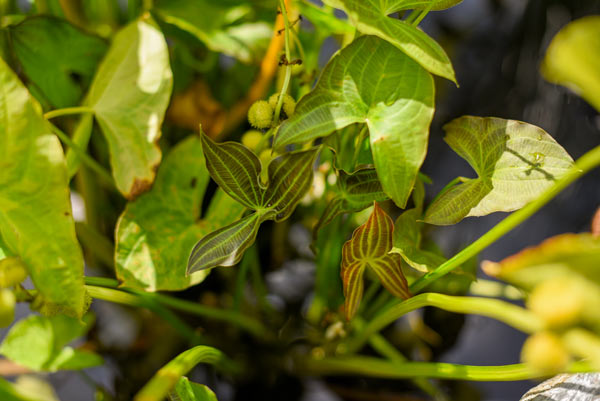
The foliage of this cultivar of native arrowhead features delicate purple netted veins.
"Understanding what part of each aquatic species to eat and how to prepare it is part of the fun of working with them," Steve says. He's tried just about every plant in the display, and while visitors may not be able to do the same, he hopes the display will inspire curiosity about these species and wonder at the idea of how they function both as important food crops and integral parts of wetland ecosystems.
From Care to Conservation
Winter weather means any aquatic display at the Garden is seasonal. The horticulture team grows aquatic plants in containers so they can be easily removed from water features for overwintering in some cases. Containers also offer design benefits, such as the ability to shift things around within a water feature throughout the season as plants spread and flower.
"Most of these plants grow really quickly, and a lot of them are kind of weedy in their natural habitat," Steve says. Regular maintenance is needed to remove senescent leaves and keep displays looking their best. Pests can also create challenges. "Grooming is a big part of care," he explains. To remove aphids in some water features, gardeners will take each individual lily leaf, for example, and splash it underwater to knock the insects off.
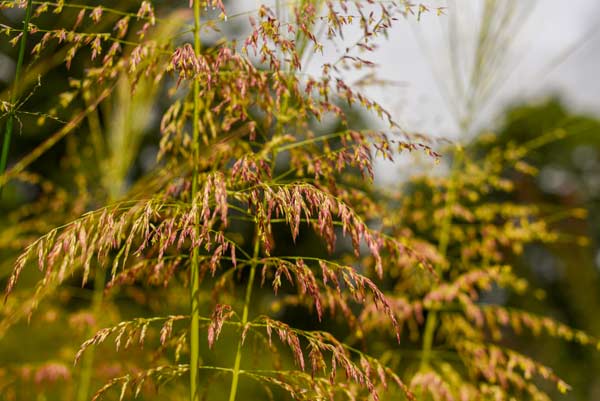
Manoomin, a native species in North American wetlands, begins to ripen.
Caring for aquatic plants at the Garden is about more than keeping up appearances. It's an opportunity for people to connect around what these plants need to thrive in their native environments. Aquatic plants make their homes in some of the region's most valuable and vulnerable ecosystems. Historically, wetlands have been drained for agriculture and lost to development, a practice that continues at pace today. When preserved, wetlands provide enormous ecological benefits from habitat to water filtration, carbon storage, and coastline resilience. In these dynamic systems, plants depend on specific conditions to thrive.
Plan a Visit
There is still time to explore the edible aquatic plant display in The Ramble—and something to spark the curiosity for visitors of all ages.
"Our edible aquatic display is intentionally placed in a family garden to get conversations started about where our food comes from and the diversity of plants," Steve says. "It connects visitors of all ages to the wider botanic world."
EXPLORE ALL THE PLANTS
Arrowhead/Duck Potato (Sagittaria australis): Native to shallow wetlands and pond edges in North America. Related species are important Indigenous food plants, harvested for starchy tubers through roasting and drying.
Chinese Lotus (Nelumbo nucifera): Cultivated in ponds and shallow basins rooted in mud. Seeds and rhizomes are widely used across Asia in both everyday cooking and celebratory foods.
Chinese Water Chestnut (Eleocharis dulcis): Cultivated in flooded fields and wetlands. Underground corms are dug at harvest and eaten fresh or cooked, especially in East and Southeast Asian cuisine.
Manoomin/Wild Rice (Zizania aquatica): Grows in shallow lakes across large swaths of North America. Manoomin is traditionally harvested by Ojibwe peoples using canoes, then processed into a valued seasonal food.
Pennywort (Centella asiatica): Pennywort grows in the moist soils around shallow water edges. This leafy green is harvested fresh and used in Southeast Asian dishes and herbal preparations.
Pickerelweed (Pontederia cordata): Native to North American shorelines and shallow water zones. Young shoots and seeds were seasonally gathered by Indigenous peoples as wetland food resources.
Rice (Oryza sativa): Harvested grains are a global staple eaten in countless everyday and ceremonial dishes. Rice roots can grow while submerged in water so farmers often flood fields to drown weeds.
Taro/Kalo (Colocasia esculenta): Grown in cultivated tropical wetlands around the world. In Hawaiʻi, kalo is a sacred ancestral crop. Cooked corms and leaves are essential for traditional and modern food systems.
Watercress (Nasturtium officinale): Watercress grows in cool, flowing water like streams and springs. Its peppery leaves are eaten fresh.
About the Author
Liz Nye is the Public Relations Manager at New England Botanic Garden. She holds a master's degree in science writing from Johns Hopkins University and enjoys learning about and writing about all things plants.