AMERICAN CHESTNUT TREE RESTORATION AT THE GARDEN
New England Botanic Garden recently became part of an American chestnut tree restoration effort that is different from many others. Led by the American Chestnut Cooperators’ Foundation (ACCF), a Virginia-based nonprofit, the effort aims to restore the iconic American chestnut tree (Castanea dentata) to its native range in eastern hardwood forests with trees that are naturally blight resistant and 100% pure American chestnuts.
That such trees even exist may come as a surprise to those familiar with the story of the American chestnut. In the early twentieth century, chestnut blight (Cryphonectria parasitica), a pathogenic fungus introduced through the nursery trade, destroyed more than 3.5 billion American chestnut trees from Georgia to Maine. The ecological, cultural, and economic fallout from losing this valuable species is hard to overstate. While the blight was catastrophic and continues to persist across the landscape snuffing out non-resistant chestnuts that make new attempts at growth, some trees did survive the original outbreak. ACCF discovered a surviving population in Virginia in the 1970s, and since then developed a traditional backcross breeding program that successfully reinforced blight resistance in new generations of American chestnuts. These trees are now ready to be tested in natural forest settings.
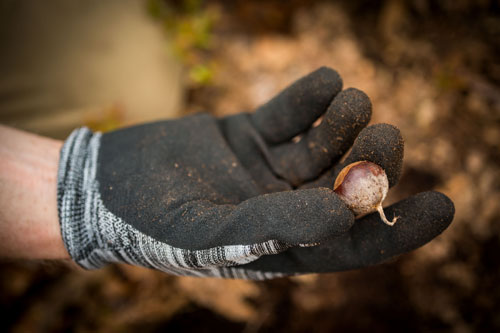
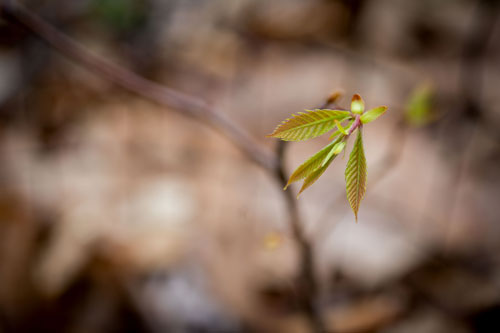
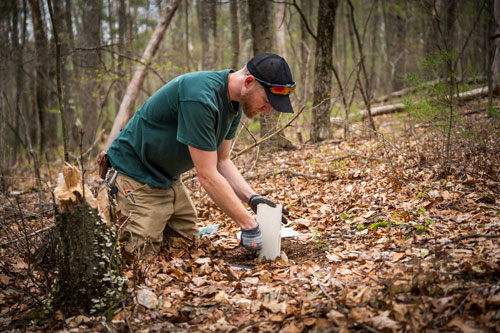
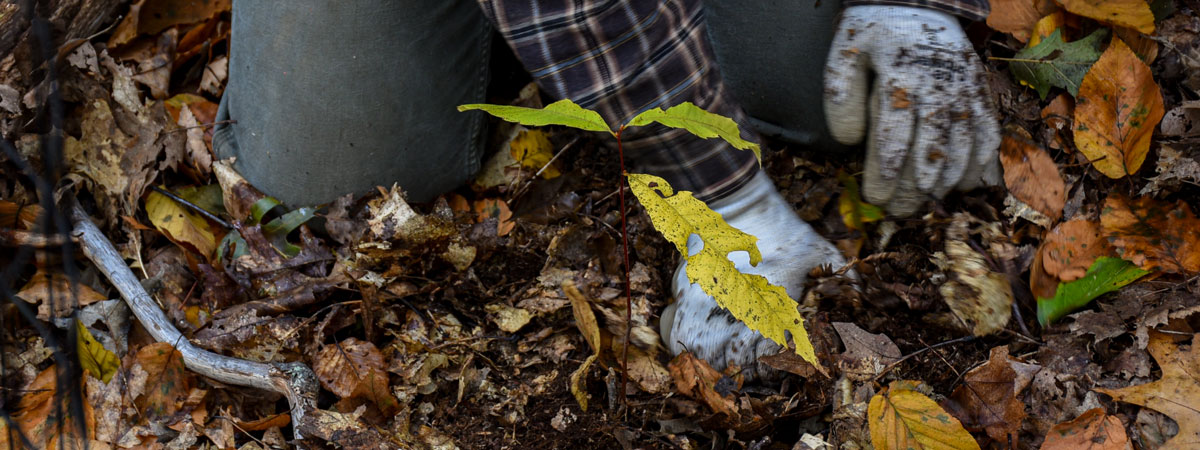
The Garden is currently serving as ACCF’s largest site for reforestation, with 160 ACCF seeds and 20 seedlings planted in a section of forest north of the Garden’s core property. This area offers perfect American chestnut habitat — sloping, rocky hillsides and a mature, mixed oak forest complete with an understory of witch hazel and mountain laurel. A heavy presence of blighted American chestnuts offers further proof of their historic presence in the area.
The planting includes American chestnut trees representing eight distinct genomes. The slightly different genetic makeup of the trees means different genomes may have better tolerance for environmental conditions, things like seasonal temperatures, precipitation, pests. The Garden will regularly collect data on how the trees perform and share this with ACCF to support the organization’s continued research and the ongoing evolution of their breeding program. How well the Garden’s trees do over time, in response to blight and other environmental factors, has the potential to inform future reforestation efforts across the Northeast. It’s a thrilling prospect that, thanks to ACCF, has already been decades in the making. We look forward to sharing more about this important work in the months and years to come.