
By Perry Ellis, Volunteer & Intern Coordinator
June 2026
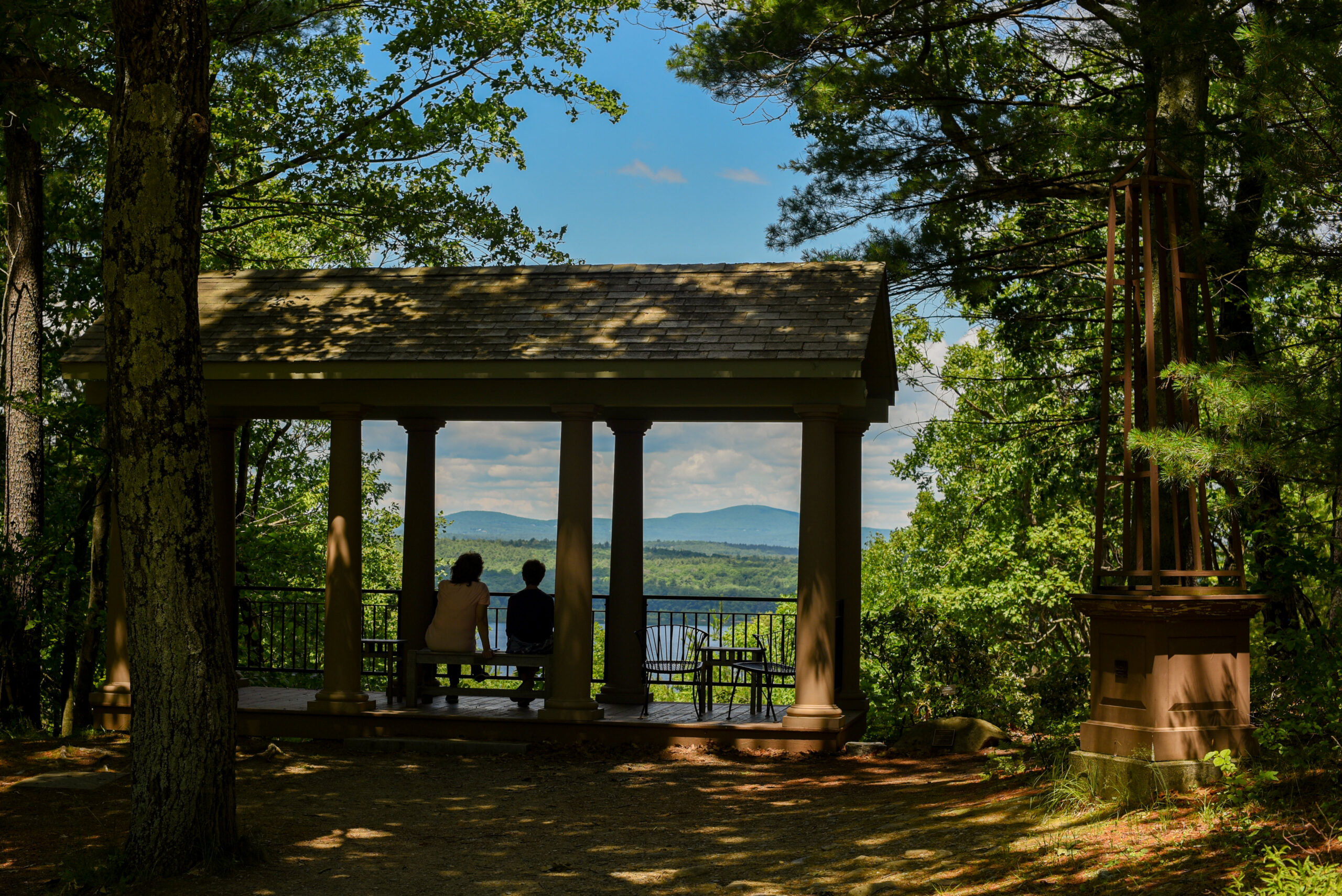 From open fields to oak forest, meadows, pine woods, and vernal pools, many different landscapes and habitat types come together at the Garden. Rising above them all is one of the highest hills in the area, Tower Hill. How did all these landscapes come to be, and how did the Hill get its name?
Understanding the land’s past from a geological perspective can help inform how our team interprets and cares for the Garden today. Plant collections, habitat preservation, and conservation initiatives celebrate a uniquely New England landscape.
Let’s Start with Glaciers
Much of the land that makes up the Garden’s nearly 200-acre footprint was shaped during the last ice age. Around 21,000 years ago, a mountain-high continental glacier poured from the north, covering nearly all of what would become New England and grinding to a halt along outer Cape Cod and Long Island. These two landforms were created from immense amounts of debris pushed into place by the glacier.
This giant glacier also shaped the land that would become Tower Hill. As the glacier moved across this landscape, it smothered the preexisting terrain. Sand was ground as fine as flour, and rocks and boulders were compressed into an enormous egg-shaped mound. The tallest, roundest point faced north, and the shorter, narrower end pointed south, the direction the glacier was moving. Thousands of years later, this mound, known as a glacial drumlin, is now the defining feature of the landscape the Garden calls home.
Oaks, Meadows, and Vernal Pools
 Fast-forward thousands of years as the climate warms and the glacier retreats from the landscape. Lichens and mosses establish on stones that carpet the ground. Wind and water deposit silt and clay. Gradually, soil accumulates over the rocks, burying them deeper and deeper as larger plants return to the landscape.
Evergreens were the first trees to return, but as temperatures continued to rise, they were gradually replaced by broadleaf forest. By 8,000 years ago, oaks had returned and become one of the dominant tree species in southern New England.
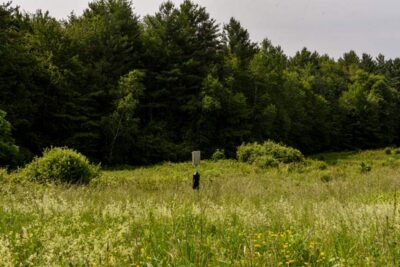
In an area southeast of the drumlin, a dip in the land begins to collect water and sediment. Over time, silt and organic matter accumulate as well. Today, this part of the Garden features a wet meadow filled with cattails and sensitive ferns that provide essential habitat for red-winged blackbirds, yellow warblers, and other bird species that depend on landscapes dotted with shrubs and filled with tall grasses.
Across New England, empty glacial gouges can still be found. Each spring, melting snow and spring rain fill these basins, forming temporary wetlands known as vernal pools. One of these pools is located in the Wildlife Garden. Warm March days bring the quacking calls of wood frogs meeting to lay their eggs in the relative safety of the pool. Vernal pools like this provide critical habitat, the only locations where a few species of frogs and salamanders can successfully reproduce.
Rocks Resurface
 Move forward again to nearly 300 years ago, when Tower Hill became part of a dairy farm. The forest was cleared to create pastures, hayfields, and cropland. This change brought an unintended consequence.
Without the insulating layer provided by the forest, winter frost could now penetrate deeper into the soil. Moisture trapped beneath buried stones froze and expanded, gradually pushing the stones upward. Each winter, more of them rose up in the fields.
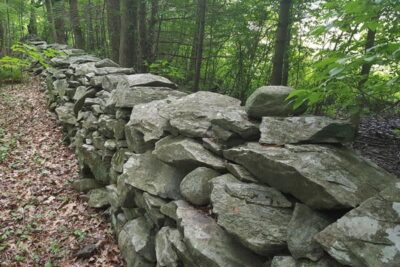
Using one problem to solve another, farmers hauled the stones to the edges of their fields and pastures, building boundary walls that kept livestock from wandering. Enough stone walls to reach beyond the Moon crisscross New England today.
The Garden’s fields and stone walls are enduring reminders of that agricultural past. So are the Farmhouse, Vegetable Garden, and historic collection of heirloom apples.
The Hill Gets Its Name
 A little more than a century ago, when the thirsty city of Boston was searching for reliable sources of fresh water, planners turned their attention to the site that would become the Wachusett Reservoir. Construction began in 1897 and transformed the landscape. More than 1,700 residents across West Boylston, Boylston, Clinton, and Sterling were displaced, over 30 miles of roadway were removed, two cemeteries were relocated, and trees and topsoil were stripped from more than 4,000 acres.
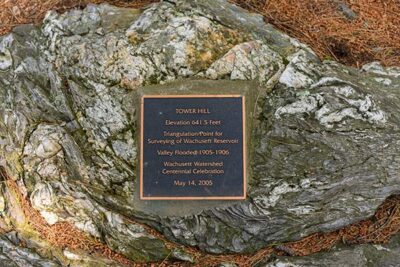
To survey the massive project, engineers built a temporary tower on a nearby hill. The tower came down when the reservoir was completed, but the name “Tower Hill” stuck in place. A plaque at the summit marks the triangulation point, the spot where the tower stood, and notes the elevation: 641.5 feet.
Other remnants of the construction project persisted, too. Thousands of eastern white pines were planted to stabilize the soil around the newly finished reservoir. Many of those trees still stand, and their descendants are the dominant trees in the Shade Garden.
A Garden for the Millennia
Today’s Garden sits in a landscape shaped over thousands of years by natural forces and human decisions. As stewards of this place, New England Botanic Garden works to preserve and enhance these natural and man-made features so they and their layers of history can be enjoyed for generations to come.
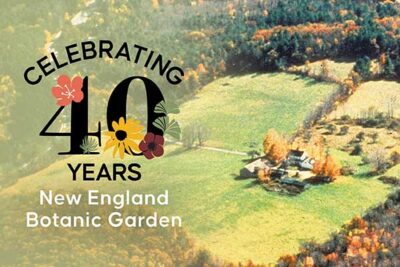 40th Anniversary
New England Botanic Garden is celebrating its 40th anniversary! Since its visionary beginnings in 1986, the Garden has grown its mission, footprint, and role in the community. Learn more on your next visit when you explore Deeply Rooted, a special anniversary exhibition that brings the Garden’s history to life, or sign up for a historic tour and learn more about the evolution of gardens and landscapes. Rediscover the past and envision the next 40 years with us!
About the Author
Perry Ellis is the Volunteer and Intern Coordinator at New England Botanic Garden. He has worked in environmental education for the majority of his career, helping students and adults gain a deeper understanding of the natural world.